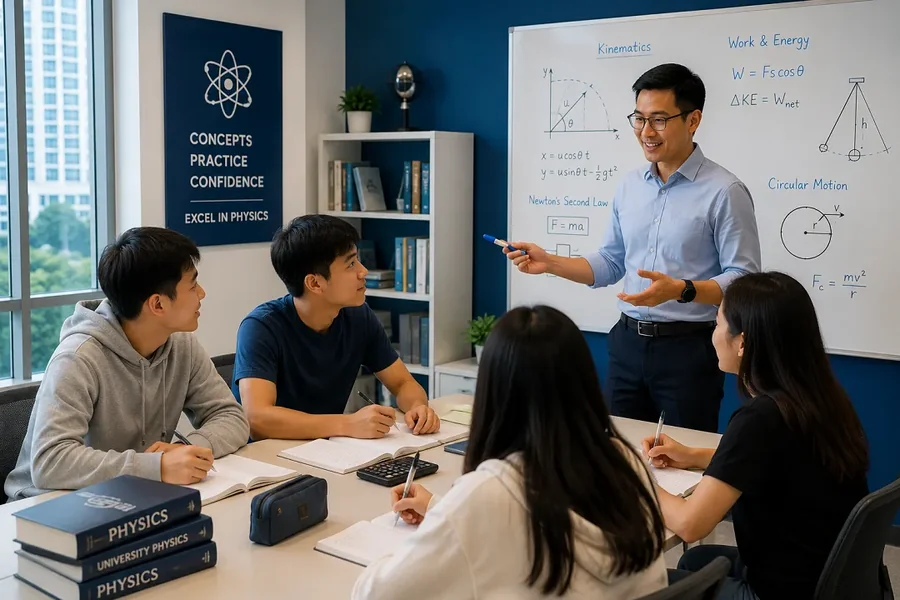
Physics is often viewed as a challenging subject because it requires students to combine scientific principles, mathematical reasoning and logical thinking. In Singapore’s education system, students are expected to do more than memorise definitions or equations. They need to understand concepts, interpret information and apply their knowledge to structured and unfamiliar problems.
For students who need additional support, physics tuition can provide a more focused environment for developing these skills. With guided explanations, targeted practice and regular feedback, learners can strengthen their understanding of difficult topics while becoming more confident when approaching examination questions.
Why Conceptual Understanding Matters in Physics
A student may remember an equation perfectly but still struggle to use it correctly. This is because physics requires an understanding of what an equation represents, when it should be applied and how different variables affect one another.
For example, learning the relationship between force, mass and acceleration is more valuable when students understand what happens when one of these quantities changes. If the mass of an object increases while the applied force remains constant, the acceleration changes accordingly. Understanding this relationship allows students to solve unfamiliar questions rather than simply looking for numbers to substitute into a formula.
Strong conceptual understanding helps students:
- Explain scientific ideas using appropriate terminology.
- Select suitable equations instead of guessing.
- Interpret diagrams, graphs and experimental information.
- Connect multiple concepts within one question.
- Identify whether an answer is physically reasonable.
These abilities are particularly important as physics questions become more demanding at higher levels.
Common Reasons Students Struggle with Physics
Students can find physics difficult for different reasons. Identifying the specific problem is often the first step towards improvement.
- Relying Too Heavily on Memorisation: Memorising formulas can provide a useful starting point, but it becomes limiting when questions are worded differently from textbook examples. Students need to understand the meaning behind each formula and recognise the situations in which it applies.
- Difficulty Visualising Abstract Ideas: Concepts involving forces, energy, electricity and waves are not always easy to picture. Diagrams, demonstrations and real-world examples can help students develop a clearer mental model.
- Weak Mathematical Foundations: Physics frequently involves rearranging equations, interpreting graphs, handling units and performing calculations. A student who is uncomfortable with algebra may understand the science but still lose marks during calculations.
- Lack of Confidence: Repeated mistakes can cause students to assume that they are simply “bad at physics”. This mindset can discourage them from attempting challenging questions. Structured practice can gradually replace uncertainty with a more systematic approach.
How Tuition Can Strengthen Conceptual Learning
A strong tuition programme should not focus exclusively on completing worksheets. The learning process should encourage students to understand the reasoning behind each answer.
A teacher can use questioning techniques to guide students towards the solution. Instead of immediately providing an equation, the student might first be asked:
- What information does the question provide?
- What quantity needs to be found?
- Which physical principle is relevant?
- Is there a diagram that can clarify the situation?
- What assumptions are being made?
This process teaches students how to think through a problem rather than depend on memorised solution patterns.
From Classroom Theory to Real-World Examples
Physics becomes easier to appreciate when students recognise it in everyday life. Singapore offers many familiar situations that can be used to reinforce classroom concepts.
| Physics Topic | Practical Example |
| Forces and motion | MRT acceleration, braking and vehicle movement |
| Energy | Energy use in household appliances |
| Electricity | Circuits, chargers and electrical devices |
| Thermal physics | Air-conditioning and refrigeration |
| Waves | Sound, communication and light |
| Pressure | Tyres, pumps and fluid systems |
For instance, when discussing thermal physics, students can consider why air-conditioning is so important in Singapore’s warm climate. Rather than memorising isolated facts about heat transfer, they can explore how thermal energy moves and how cooling systems operate.
Such examples give abstract concepts a practical context and can make revision more meaningful.
Building Exam Confidence Through Structured Practice
Exam confidence is not simply about completing a large number of practice papers. Students need to understand how to approach different types of questions and learn from their mistakes.
A useful revision cycle might involve:
- Understand: Review the underlying concept before attempting difficult questions.
- Apply: Solve basic problems to confirm that the concept can be used correctly.
- Challenge: Attempt unfamiliar or multi-step questions that require deeper reasoning.
- Review: Analyse incorrect answers and identify exactly where the reasoning went wrong.
- Repeat: Revisit weaker areas after a suitable interval to strengthen retention.
This approach can be particularly useful for students preparing for major assessments because it turns mistakes into learning opportunities and encourages more consistent, independent revision habits.
Using Mistakes as a Learning Tool
Students often focus on whether an answer is correct without examining the reasoning that produced it. However, analysing mistakes can reveal important gaps in understanding.
For example, a student may lose marks because they:
- Used an inappropriate formula.
- Forgot to convert units.
- Misread a graph.
- Confused two related concepts.
- Made an algebraic error.
- Provided an incomplete explanation.
- Failed to state an appropriate conclusion.
Maintaining an error log can help students identify recurring patterns. Instead of repeatedly practising everything, they can focus revision time on areas that genuinely require improvement.
Supporting Students Across Singapore’s Academic Journey
Physics requirements can change as students progress through their academic years. Earlier learning typically establishes foundational ideas, while more advanced study requires students to combine concepts and apply them in increasingly complex situations.
Parents should therefore consider whether tuition is helping a student develop skills progressively rather than simply preparing for the next test.
Useful indicators include:
| Area | Positive Progress |
| Understanding | Student can explain concepts independently |
| Application | Student can tackle unfamiliar questions |
| Accuracy | Fewer calculation and unit errors |
| Reasoning | Answers include logical explanations |
| Confidence | Student is more willing to attempt challenging problems |
| Independence | Student can identify and correct mistakes |
Mavis Tutorial Centre can be considered by families seeking structured academic support, particularly when students benefit from additional explanations and guided practice. The most important consideration is whether the teaching approach addresses the learner’s individual needs and encourages genuine understanding.
Practical Ways Parents Can Support Physics Learning
Parents do not necessarily need advanced physics knowledge to support their child’s progress. They can encourage habits that make learning more consistent and reflective.
Simple strategies include:
- Ask the student to explain a concept in their own words.
- Encourage them to draw diagrams before solving complex problems.
- Discuss everyday examples of physics.
- Help them maintain a regular revision schedule.
- Encourage review of incorrect answers rather than focusing only on marks.
- Celebrate improvement in understanding and effort, not just grades.
A calm and supportive home environment can also reduce the pressure students may feel when dealing with a difficult subject.
Developing Long-Term Confidence in Physics
Confidence grows when students have a reliable process for dealing with uncertainty. A learner who knows how to identify relevant information, select a principle, work through calculations and check an answer is better equipped to handle unfamiliar questions.
This is particularly important because examination questions may not always resemble examples previously encountered in class. Students who understand the underlying concepts can adapt their knowledge to new situations.
Over time, this can encourage greater independence. Instead of immediately looking for a model answer, students become more willing to investigate the problem themselves.
Final Thoughts
Physics is not simply a subject of equations and calculations. It teaches students how to understand relationships, analyse evidence and use logical reasoning to explain how the world works. Building these skills can make both classroom learning and examination preparation more purposeful, while encouraging students to approach challenging topics with patience and curiosity.
The right physics tuition can support students by strengthening conceptual understanding, providing targeted practice and developing a systematic approach to problem-solving. With consistent effort and appropriate guidance, students can become more confident in tackling unfamiliar questions and more independent in their learning. Parents seeking structured academic guidance can explore Mavis Tutorial Centre through mavistutorial.com, where focused learning can help students build stronger foundations and prepare more effectively for future academic challenges.
Frequently Asked Questions
1. How does physics tuition improve conceptual understanding?
Physics tuition can provide additional explanations and opportunities for students to explore difficult concepts at a suitable pace. Teachers can identify misunderstandings and address them before they become persistent weaknesses. Students can also practise applying theories to different question formats.
2. Can physics tuition improve examination confidence?
Yes, structured practice can help students become more familiar with the reasoning required in examination questions. Regular feedback can also help them recognise and correct recurring mistakes. As students see improvement in their problem-solving ability, their confidence can gradually increase.
3. Should students focus on formulas when studying physics?
Formulas are important, but memorising them without understanding their meaning can create difficulties. Students should learn what each variable represents, what conditions apply and how the relationship can be used. This makes it easier to select the correct equation in unfamiliar situations.
4. How can students prepare for difficult physics questions?
Students should first understand the relevant concept before attempting increasingly challenging problems. Drawing diagrams, listing known quantities and checking units can make multi-step questions more manageable. Reviewing mistakes after each practice session is equally important.
5. When should parents consider additional physics support?
Parents may consider additional support when a student repeatedly struggles with concepts, calculations or examination questions despite regular school practice. Early intervention can prevent small gaps from becoming larger weaknesses. However, the right timing depends on the student’s needs, academic level and learning progress.