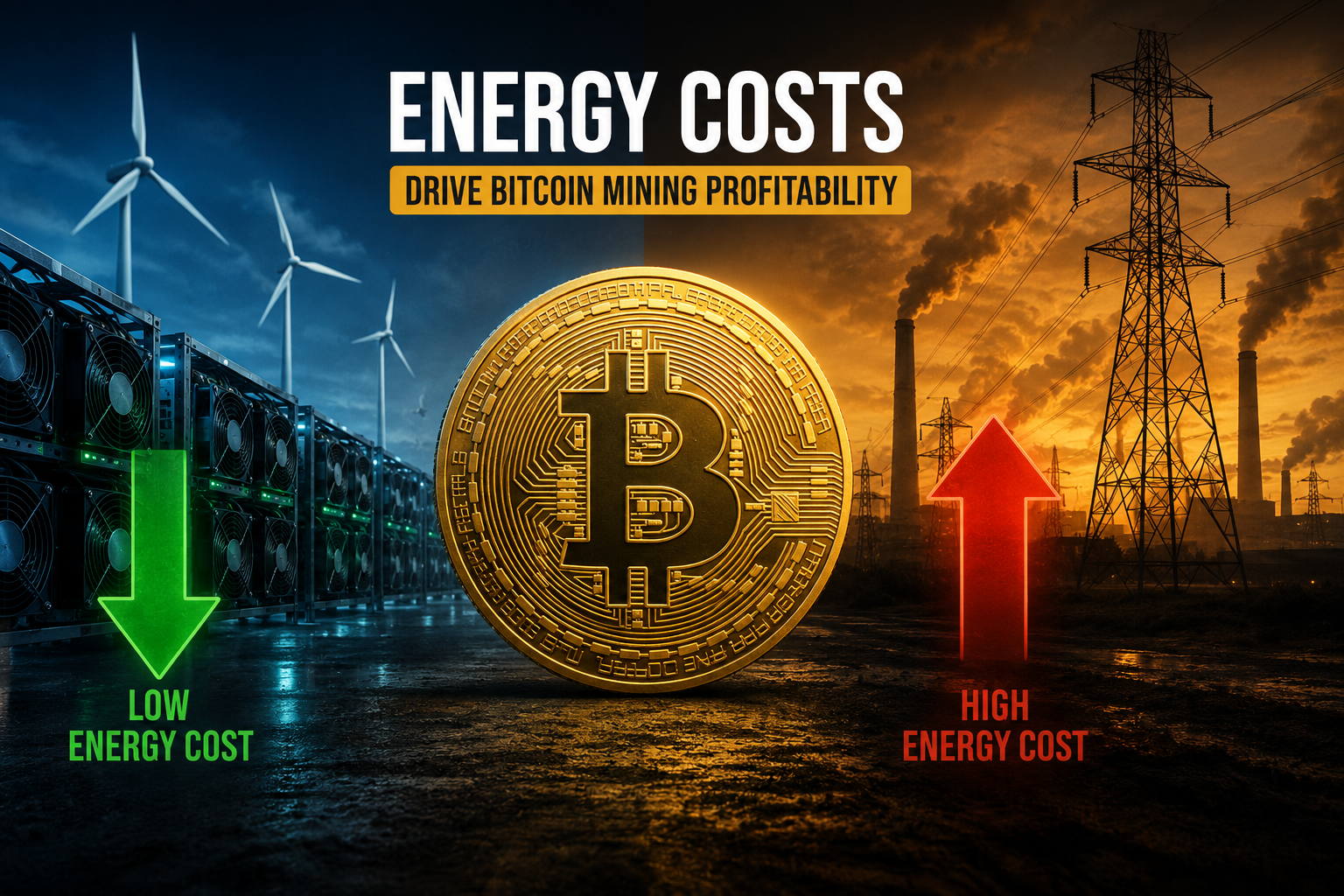
Bitcoin mining is a highly competitive, global energy arbitrage business. With the network automatically adjusting its difficulty and block rewards getting slashed in half every four years, miners are constantly fighting tightening profit margins. In 2026, finding cheap electricity isn't just a clever strategy, it is an absolute matter of survival. When the broader crypto market fluctuates wildly, your power bill is the only major variable you can truly control.
How Bitcoin Mining Profitability Works
To understand the business of mining, you have to look at the delicate balance between money coming in and money going out:
- Mining revenue: This comes from block rewards (currently 3.125 BTC per block), network transaction fees, and the ever-changing market price of Bitcoin itself. Savvy operators consistently monitor market conditions and choose to View BTC/USDT price trends to time their liquidations perfectly, locking in maximum fiat revenue during bullish cycles.
- Mining costs: These include electricity, ASIC hardware purchases, facility cooling, hosting, routine maintenance, and mining pool fees.
The April 2024 Bitcoin halving slashed the new supply of Bitcoin, meaning miners are now doing the same amount of work for half the base reward. Consequently, the global network hashrate has surged, making extreme energy efficiency more critical than ever before.
Why Electricity Costs Are the Biggest Profitability Driver
Electricity Cost per kWh and Miner Margins
Electricity represents up to 80% of a miner's ongoing operational expenses (OpEx). Even a tiny $0.02 increase per kilowatt-hour (kWh) can turn a highly profitable mining farm into a massive financial liability overnight.
ASIC Power Consumption and Mining Efficiency
Miners use specialized computers called Application-Specific Integrated Circuits (ASICs). The efficiency of an ASIC is measured in Joules per Terahash (J/TH). If electricity is expensive, only miners running the absolute latest, most efficient ASICs (under 20 J/TH) can keep their heads above water. Older, power-hungry machines are the first to get unplugged.
When High Energy Costs Make Bitcoin Mining Unprofitable
Bitcoin Mining Break-Even Cost: How Energy Prices Change the Math
The "break-even cost" is the price Bitcoin must maintain for a miner to pay their bills. If it costs $50,000 in electricity to mine one coin, but Bitcoin is trading at $45,000, the miner is operating at a loss.
Profitability at Different Electricity Rates
Here is a realistic look at how power costs affect a miner’s bottom line in 2026 (assuming modern hardware):
|
Power Scenario |
Est. Electricity Rate (per kWh) |
Est. Cost to Mine 1 BTC |
Profitability Status |
|
Low-cost power |
$0.03 – $0.04 |
$30,000 – $35,000 |
Highly Profitable |
|
Average-cost power |
$0.06 – $0.07 |
$45,000 – $55,000 |
Moderate (Depends on BTC Price) |
|
High-cost power |
$0.10+ |
$75,000+ |
Unprofitable |
(Note: Exact costs vary alongside global network difficulty and individual hardware setups).
Other Key Factors That Affect Bitcoin Mining Profitability
While electricity is king, it doesn't rule alone. Other variables include:
- Bitcoin price volatility: A sudden price drop instantly compresses profit margins.
- Network difficulty and global hashrate: As more miners join the network, the puzzle difficulty increases. Higher difficulty means more energy is spent to win the same amount of BTC.
- Hardware efficiency: Upgrading rigs is expensive but necessary to stay competitive.
- Cooling and climate conditions: Running mining rigs in a hot climate costs significantly more in cooling than operating near the Arctic Circle.
- Mining pool and operational fees: Most miners pool their computing power and pay a 1-2% fee to operators for consistent payouts.
Regional Energy Costs and Bitcoin Mining Locations
Because digital mining can happen anywhere with an internet connection, miners are highly mobile. They flock to regions with abundant, cheap power, such as areas with massive hydroelectric dams or wind farms.
Local regulations can make or break a mining hub. Some regions welcome miners as buyers of last resort for excess energy. In contrast, heavy taxes can erase profitability. For example, to address environmental concerns, researchers have analyzed international frameworks that could impose a corrective carbon tax on crypto miners up to $0.045 per kWh (Hebous & Vernon-Lin, 2024). Such policies naturally push miners to seek out greener, tax-friendly jurisdictions.
Renewable Energy and Bitcoin Mining Profitability
Can Renewable Energy Lower Bitcoin Mining Costs?
Yes, and it is becoming the industry standard. Bitcoin mining is increasingly leveraged as a "Productive Use of Energy" (PUE) to subsidize solar micro-grids, helping offset the heavy capital costs of building new renewable infrastructure (Hallinan et al., 2023).
Stranded Energy, Flared Gas, Hydro, Solar, and Wind Mining Models
- Stranded Energy & Flared Gas: Miners capture waste methane from oil fields, turning a harmful environmental byproduct into cheap electricity. Forward-thinking infrastructure companies closely monitor global energy benchmarks like USOILUSDT to stay ahead of shifting fossil fuel production cycles and optimize their off-grid partnerships.
- Hydro, Solar, and Wind: Renewables offer incredibly low variable costs. Miners can set up shop directly at the power source, utilizing off-peak energy that would otherwise be completely wasted.
How Miners Reduce Energy Costs and Protect Profit Margins
Surviving in the mining sector requires strategic cost reduction:
- Long-term power purchase agreements (PPAs): Locking in fixed utility rates for years at a time.
- Demand response and curtailment programs: Miners agree to shut off their machines during peak grid hours in exchange for financial credits.
- Upgrading to efficient ASIC miners: Regularly rotating out old hardware.
- Immersion cooling and heat reuse: Submerging rigs in dielectric fluid saves cooling power, and the generated heat can be sold to warm local greenhouses or homes.
- Geographic diversification: Spreading operations across multiple countries to hedge against localized regulatory or grid risks.
Future Outlook: Energy Costs, Bitcoin Mining, and Miner Survival
The 2024 halving permanently reset the baseline for profitability. Miners have less room for error than ever.
Looking ahead through 2026, miners are facing a new rival: AI data centers. The generative AI boom requires massive computational power, and AI companies are actively competing with Bitcoin miners for the same cheap, high-capacity energy contracts.
Only agile operators who secure rock-bottom electricity rates, integrate directly with renewable power grids, and heavily optimize their hardware lifecycle will survive the squeeze.
Conclusion: Energy Costs Can Decide Whether Bitcoin Mining Is Profitable
At its core, Bitcoin mining has matured from a tech-savvy hobby into an industrial-scale energy optimization game. The market rewards those who can source the cheapest, most efficient power. Ultimately, mastering energy costs is what separates the thriving mining enterprises from those forced to unplug.
Frequently Asked Questions
What electricity price is profitable for Bitcoin mining?
Generally, an electricity rate under $0.06 per kWh is considered safe, though rates under $0.04 per kWh are ideal for sustaining long-term, high-margin profitability.
How much does it cost to mine 1 Bitcoin?
In 2026, depending on your hardware efficiency and local utility rates, the cost to mine a single Bitcoin typically ranges between $30,000 and $55,000.
Is Bitcoin mining still profitable in 2026?
Yes, but the barrier to entry is high. It is highly profitable for large-scale operations with access to cheap, renewable energy and top-tier ASIC machines, but very difficult for small, at-home miners.
How does Bitcoin price affect mining profitability?
Mining revenue is directly tied to the price of BTC. If a miner spends $45,000 to mine a coin and the market price of Bitcoin drops to $40,000, the miner operates at a net loss.
Can renewable energy make Bitcoin mining more profitable?
Absolutely. By utilizing "stranded" energy, like off-peak solar, excess hydro, or flared natural gas, miners can secure power for pennies, significantly lowering their overall cost basis.


 By
By