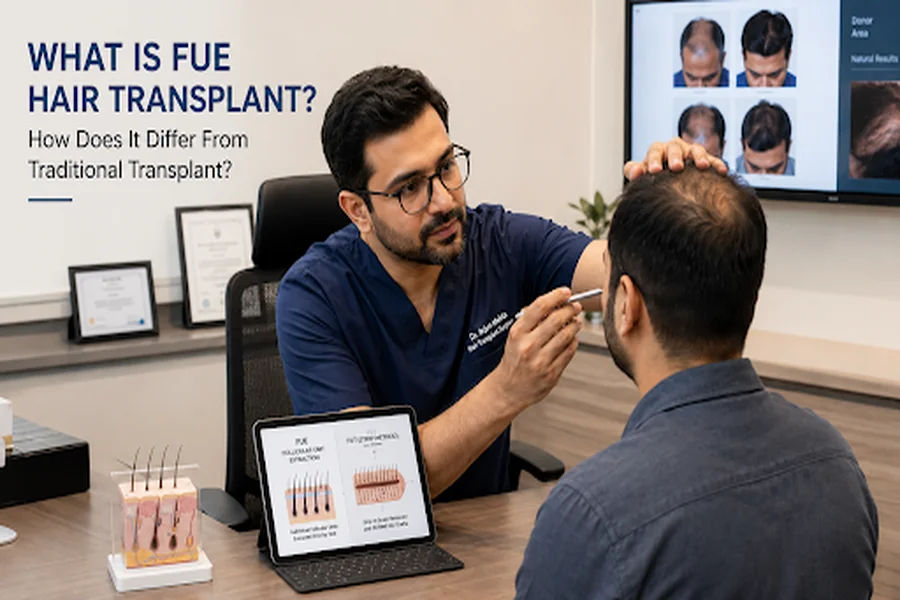
FUE and FUT both involve transferring a person’s own donor hair to thinning or bald areas of the scalp. The primary difference lies in how the hair follicles are extracted. In FUE, follicular units are removed individually, while in FUT, a thin strip of donor scalp is removed and divided into individual grafts.
When researching hair transplant procedures, the term FUE appears almost everywhere. Many advertisements describe it as a modern, painless and scar-free method, while traditional hair transplantation is often presented as outdated. Although this comparison sounds straightforward, it is not entirely accurate.
FUE and FUT are both established hair transplant techniques. Their goal is the same: to remove healthy hair follicles from an area with sufficient density and implant them into thinning or bald areas.
The main differences relate to the method of graft extraction, the type of scarring, recovery time and the number of grafts that may be obtained in one session.
The right option should not be selected simply because one technique is newer. Age, hair-loss pattern, donor-area quality, scalp condition, hairline requirements and the possibility of future hair loss must all be considered.
First, Understand That a Hair Transplant Does Not Create New Hair
A hair transplant does not make the body produce new follicles. The surgeon relocates existing follicles from the back or sides of the scalp to the frontal hairline, crown or other thinning areas.
The donor area must therefore be treated as a limited resource. Once too many follicles have been removed, they cannot be placed back into the donor area.
A successful transplant is not only about placing as many hairs as possible at the front. Preserving donor density, designing an age-appropriate hairline and planning for future hair loss are equally important.
A very low or completely straight hairline may initially appear dense, but it can look unnatural as the person grows older or if the surrounding natural hair continues to thin.
What Is an FUE Hair Transplant?
FUE stands for Follicular Unit Extraction or Follicular Unit Excision.
During the procedure, the surgeon uses a small circular micropunch to remove follicular units individually from the donor area. Each follicular unit may contain between one and four hairs.
The extracted grafts are stored in a suitable solution before being implanted into small recipient sites created in the thinning or bald area.
In an FUE hair transplant, a long strip of skin is not removed from the donor area. As a result, the procedure does not leave a long linear scar.
Instead, it may leave several small, dot-like scars. When the grafts are extracted with appropriate spacing and technique, these marks are generally difficult to notice. However, excessive extraction can make the donor area appear patchy or visibly thin.
What Is a Traditional FUT or Strip Hair Transplant?
FUT stands for Follicular Unit Transplantation and is commonly referred to as the strip method.
During FUT, the surgeon removes a thin strip of hair-bearing skin from the donor area. The incision is then closed using sutures or staples.
The strip is examined under a microscope and divided into individual follicular-unit grafts. These grafts are subsequently implanted into the thinning or bald areas of the scalp.
FUT can leave a linear scar in the donor area. The scar is often concealed by longer hair, but it may become visible when the hair is cut very short.
In suitable patients, FUT may allow the surgical team to obtain a large number of grafts in a single session without spreading punch extraction across a wider donor area.
FUT should therefore not automatically be described as an outdated or inferior technique. It may still be appropriate for patients who require a larger number of grafts, have a suitable donor scalp and are comfortable with the possibility of a linear scar.
FUE vs FUT: Key Differences
| Basis of comparison | FUE | FUT or strip method |
| Graft extraction | Follicles are removed individually using a micropunch | A strip of skin is removed and divided into grafts |
| Scarring | Small dot-like scars; no long linear scar | A linear scar may remain in the donor area |
| Hairstyle | Often more suitable for people who prefer shorter hairstyles | The linear scar may be visible with very short hair |
| Recovery | No stitches in the donor area; initial recovery is generally quicker | Sutures and the strip incision may cause greater tightness or discomfort |
| Large sessions | Extracting a high number of grafts can take longer and may increase the risk of overharvesting | A high number of grafts may be obtained in suitable patients |
| Procedure time | Individual extraction can make the procedure lengthy | Preparing grafts from the strip requires an experienced microscopic-dissection team |
| Best candidate | Depends on donor quality, hairstyle preference, graft requirements and long-term planning | Depends on donor quality, graft requirements and acceptance of a linear scar |
Who Should Consider a Hair Transplant?
Not everyone experiencing hair loss is immediately suitable for a transplant.
Sudden hair shedding may be related to fever, rapid weight loss, thyroid problems, iron deficiency, childbirth, prolonged stress or certain medications. In such cases, identifying and treating the underlying cause may be necessary before considering surgery.
Hair transplantation is generally considered when:
1.The pattern of hair loss is reasonably established
2. The donor area contains sufficient healthy follicles
3. A clearly thinning or bald area requires coverage
4. Hair loss is permanent rather than temporary
5. The patient has realistic expectations
6. The scalp is healthy enough for surgery
Active scalp infections, uncontrolled inflammation, a very weak donor area or unrealistic expectations may make surgery unsuitable or require it to be postponed.
Why Are Medical Assessment and Long-Term Planning Important?
A receding hairline or thinning crown is not only a present concern. Pattern hair loss may continue to progress over time.
When the frontal area is transplanted but the non-transplanted hair behind it continues to thin, an empty gap may eventually appear between the transplanted and natural hair.
This is why patients should not focus only on the number of grafts required.
During a consultation at a doctor-led hair transplant clinic, the medical team should assess:
1. The cause and pattern of hair loss
2. Donor density
3. Hair thickness and texture
4. The extent of follicular miniaturisation
5. The possibility of future hair loss
6. The number of grafts that can be safely extracted
7. The potential need for medical treatment
8. How donor hair should be preserved for future procedures
A clinic should ideally use standardised photographs, scalp examination and, where required, trichoscopy to explain the treatment plan.
Providing a fixed graft count through a phone call or based only on mobile photographs may not constitute a complete medical assessment.
Main Stages of an FUE Hair Transplant
A typical FUE procedure involves several steps. Exact protocols may vary between clinics, but the general process usually includes the following.
1. Hairline and Graft Planning
The surgeon designs the hairline and plans the distribution of grafts based on facial proportions, age, existing hair direction, baldness pattern and donor capacity.
The surgeon must also decide which areas require priority coverage and how much donor hair should be preserved for the future.
2. Local Anaesthesia
Local anaesthesia is administered to numb the donor and recipient areas. The patient generally remains awake during the procedure.
Some discomfort may be felt while the anaesthetic is being administered, but the purpose is to minimise pain during extraction and implantation.
3. Donor Extraction
Follicular units are removed one by one using a micropunch.
Maintaining appropriate spacing between extraction points is important. Removing too many grafts from one area can create patchiness, visible thinning or permanent donor depletion.
4. Graft Examination and Storage
The extracted grafts are counted, examined and sorted according to the number of hairs they contain.
They are stored in a suitable solution to keep them hydrated. Excessive handling, dehydration or prolonged time outside the body can affect graft quality.
5. Creation of Recipient Sites
Small openings or slits are created in the area where the grafts will be implanted.
The angle, direction, depth and distribution of these sites strongly influence how natural the final result appears.
6. Graft Implantation
The grafts are placed according to their thickness and the number of hairs they contain.
Single-hair grafts are generally placed along the front of the hairline to create a softer and more natural-looking edge. Multi-hair grafts may be positioned behind them to improve visual density.
7. Discharge and Aftercare
After surgery, the patient receives instructions regarding:
1. Medication
2. Sleeping position
3. Scalp washing
4. Physical activity
5. Sun exposure
6. Touching or scratching the grafts
7. Follow-up appointments
Following these instructions carefully can help reduce complications and protect the newly implanted grafts.
Is FUE Completely Scar-Free?
No. FUE does not create a long linear scar, but every punch makes a small opening in the skin.
After healing, tiny dot-like scars may remain. These are often difficult to notice under normally styled hair, but they may be visible when the scalp is fully shaved or examined closely.
The appearance of the donor area can be influenced by:
1. Punch size
2. Extraction angle
3. Spacing between grafts
4. Number of grafts removed
5. Distribution of extraction points
6. Skin-healing characteristics
7. Previous procedures
Claims that FUE is completely scarless should therefore be approached carefully.
What Should Patients Expect During Recovery?
Mild swelling, redness, sensitivity and small scabs may occur during the first few days after the procedure.
Patients should wash the scalp according to the surgeon’s instructions and avoid rubbing, scratching or picking at the transplanted area.
Many people can resume light daily activities within a few days. However, complete scalp healing takes longer, and strenuous activity may need to be avoided temporarily.
The transplanted hair shafts may fall out during the initial weeks. This can be concerning, but shedding does not necessarily mean that the follicles have been lost. The follicles may remain beneath the skin and enter a temporary resting phase.
New growth commonly begins to appear after a few months. Hair thickness, length and density improve gradually.
A general recovery timeline may look like this:
1. First 7 to 10 days: Redness, scabbing and mild swelling begin to settle
2. 2 to 8 weeks: Transplanted hair may shed
3. 3 to 4 months: Early new growth may begin
4. 6 to 9 months: Visible improvement in coverage and thickness
5. 12 to 18 months: The result can be assessed more completely
The timeline varies depending on the patient and the area treated. Crown growth may take longer than frontal hairline growth.
What Should Patients Look for When Choosing a Surgeon and Clinic?
The name of the technique is important, but who performs the procedure and how it is performed matter even more.
Using the term FUE does not automatically make a procedure safe or guarantee a natural result. Hairline design, recipient-site creation, donor management and graft handling all require medical and surgical judgement.
During consultation, patients should ask:
1. Who will diagnose the cause of hair loss?
2. Who will design the hairline?
3. Who will administer anaesthesia?
4. Who will extract the grafts?
5. Who will create the recipient sites?
6. Who will implant the follicles?
7. How will the grafts be counted and stored?
8. How will donor overharvesting be prevented?
9. What follow-up support is provided?
10. What happens if growth is lower than expected?
Potential warning signs include:
1. Selling a package before examining the scalp and donor area
2. Recommending the same number of grafts to every patient
3. Promising a 100% guaranteed result
4. Claiming that there will be no scarring
5. Failing to explain the doctor’s role
6. Avoiding discussion about future hair loss
7. Pressuring the patient to pay immediately
8. Promising full density despite limited donor availability
FUE or FUT: Which Technique Is Better?
There is no one-word answer to this question.
FUE may be suitable for someone who:
1. Prefers shorter hairstyles
2. Wants to avoid a linear scar
3. Requires a limited or moderate number of grafts
4. Has a donor area suitable for individual extraction
5. Prefers a relatively quicker initial donor recovery
FUT may be considered when:
1. A large number of grafts is required
2. The donor scalp is suitable for strip removal
3. The patient usually keeps longer hair
4. A linear scar is acceptable
5. Long-term donor management supports the technique
6. Previous procedures have affected the availability of donor hair
Previous surgeries, scalp flexibility, donor density and future graft requirements may also influence the decision.
The best technique is the one that meets the patient’s actual needs while preserving the donor area for the future.
A procedure should not be selected only because it is popular, heavily advertised or worked well for a friend.
Conclusion
FUE and FUT both use the patient’s own hair follicles to restore thinning or bald areas.
In FUE, grafts are removed individually, which avoids a long linear scar and may be more suitable for people who prefer shorter hairstyles. In FUT, a strip of donor skin is removed and divided into individual grafts. This may leave a linear scar but can provide a high number of grafts in suitable patients.
The decision should not be based only on the name or popularity of the technique. Diagnosis, donor capacity, graft requirements, hairline design and future hair-loss progression must all be considered.
A detailed assessment by a qualified dermatologist and hair-transplant surgeon is the most important first step towards selecting an appropriate and sustainable treatment plan.
Frequently Asked Questions
Is an FUE hair transplant painful?
The procedure is performed under local anaesthesia to minimise discomfort during surgery. Patients may feel a brief stinging sensation while the anaesthetic is administered, followed by mild tenderness or tightness after the procedure.
Does FUE leave no scars?
FUE does not leave a long linear scar, but small dot-like scars may remain at the extraction points. With appropriate technique and conservative extraction, they are generally difficult to notice.
When does transplanted hair begin to grow?
The transplanted hair shafts may shed during the first few weeks. New growth commonly begins around the third or fourth month, while the result continues to develop over 12 to 18 months.
Does a hair transplant stop the remaining natural hair from falling?
No. A hair transplant does not automatically stop progressive hair loss in the surrounding non-transplanted hair. A doctor may recommend medical treatment or ongoing monitoring to preserve existing hair.
Is FUT no longer performed?
FUT is still used in selected patients. Its suitability depends on graft requirements, donor-scalp characteristics, hairstyle preferences and whether the patient accepts a linear scar.
This article is intended for general educational purposes and does not replace personalised diagnosis, medical advice or treatment from a qualified healthcare professional.


 By
By